Getting mycelium to colonize a block is satisfying. Getting it to fruit reliably is where the real work begins. Temperature, fresh air exchange, and light are the three variables that trigger and sustain fruiting in gourmet species, and each one does something specific. Understanding what they do, not just what numbers to hit, makes the difference between a flush that performs and one that stalls.
Temperature: The Signal That Fruiting Has Started
Most gourmet species fruit in response to a temperature drop. When the substrate cools relative to the colonization period, the mycelium reads that as a shift toward autumn conditions and begins pinning. The exact range varies by species, but the principle holds broadly.
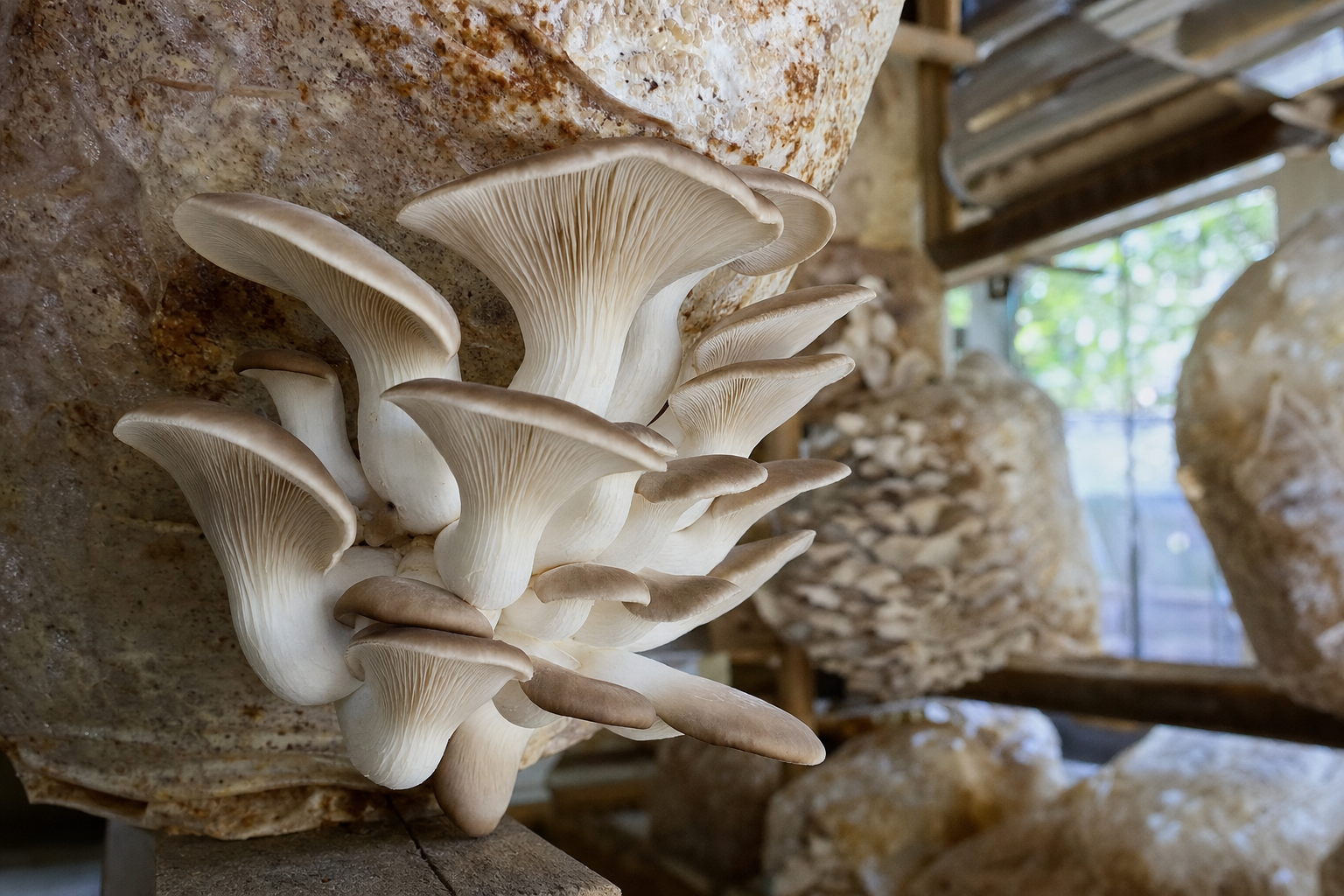
Oyster mushrooms
Blue and pearl oyster varieties pin most reliably between roughly 55°F and 75°F. Pushing temperatures above that range tends to produce thin, fast-opening caps that lose quality before harvest. Pink and yellow oysters tolerate warmer conditions and stall below 65°F.
Lion’s mane
Lion’s mane prefers the cooler end of the gourmet spectrum, typically 60°F to 70°F. Higher temperatures cause browning on the developing teeth before the fruitbody fills out, a common frustration for growers who run their fruiting space warm.
Shiitake
Shiitake blocks often need a deliberate cold shock, soaking in cold water or moving the block to a cooler space for 12 to 24 hours, to break dormancy after colonization. Without that signal, a well-colonized block can sit for weeks without initiating pins.
The takeaway is not a single target number. It is that each species has a preferred range, and a drop from colonization temperature is often what starts the process.
Fresh Air Exchange: More Than Just Oxygen
Mycelium produces carbon dioxide as it metabolizes. In a sealed or poorly ventilated space, CO2 accumulates and suppresses pinning. Fresh air exchange, abbreviated FAE in most cultivation communities, dilutes that CO2 and replaces it with oxygen-rich air. This is what pins actually need to initiate and elongate normally.
What high CO2 looks like
- Pins that form but stretch toward any available gap in the bag or container
- Long, thin stems with small or underdeveloped caps
- Fruitbodies that abort before reaching harvest size
- Slow or absent pinning on blocks that colonized cleanly
Practical FAE approaches
FAE does not require a complex system. Many small-scale growers achieve adequate exchange with a small fan running on a timer, several short exchanges per day rather than continuous high-velocity airflow. The goal is to move stale air out and fresh air in without stripping too much moisture from the substrate surface, which is where humidity and FAE interact.
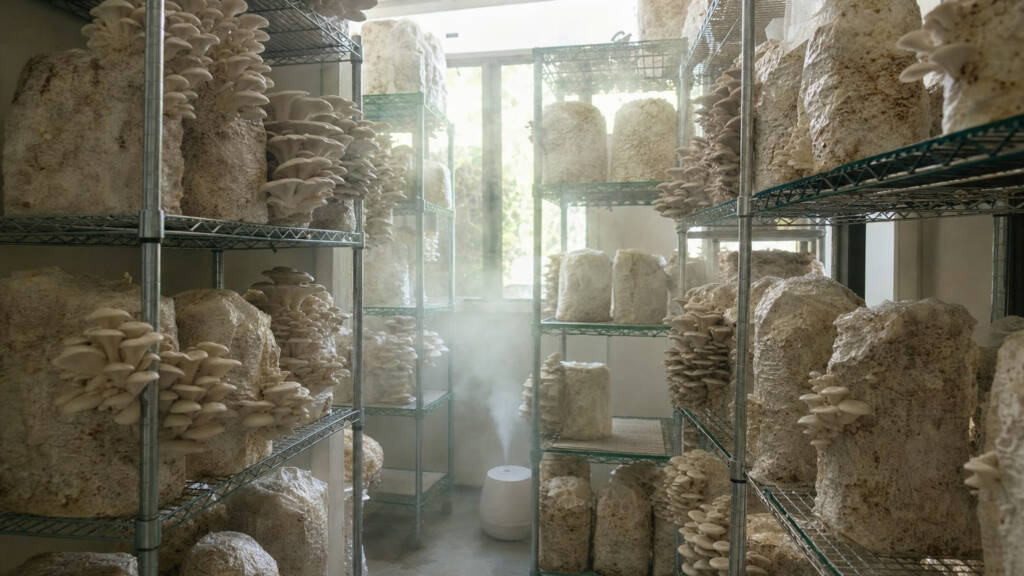
Fruiting tents, martha setups, and shotgun fruiting chambers all handle FAE differently. The method matters less than the result: CO2 levels low enough that fruitbodies develop normally shaped caps relative to their stems.
Light: A Directional Cue, Not an Energy Source
Mushrooms are not plants. They do not photosynthesize, and they do not need intense light to produce. What light does in fruiting is provide a directional signal. Pins grow toward light, which is how fruitbodies orient themselves in nature, emerging from substrate toward open sky.
How much light is enough
Indirect natural light from a window or a few hours of low-wattage artificial light per day is sufficient for most gourmet species. Many growers use a simple timer on a standard grow bulb for 12 hours on and 12 hours off. The intensity matters far less than consistency and direction.
What happens without light
Fruitbodies grown in complete darkness tend to produce elongated stems and small caps, the same morphology as high-CO2 growth, which is why the two problems are often confused. If your pins are stretching and you have already addressed FAE, check whether the fruiting space is getting any light at all during the day cycle.
How the Three Variables Work Together
Temperature sets the stage. FAE keeps CO2 low enough for pins to form and develop. Light gives those pins a direction to grow. When one variable is off, the symptoms often overlap, small caps, slow pinning, aborted fruitbodies, which makes diagnosing the actual cause harder.
The practical approach is to address all three before your blocks enter the fruiting stage rather than troubleshooting after pins have already stalled. A colonized block that enters a well-dialed fruiting environment is far more likely to produce a full flush than one that gets corrected mid-cycle.
Species Selection Affects All of This
The fruiting parameters above only work predictably when you start with genetics that are stable and documented. A liquid culture or spawn that has not been verified for performance introduces a variable that no amount of environmental tuning can fix. If a strain has not been tested for pin initiation at a known temperature and CO2 level, you are working blind.
That is the case for sourcing genetics the same way you source your environmental data: from something verified rather than assumed. MycoStock’s guide to locally grown mushroom varieties covers how species differences show up in real cultivation, useful context if you are deciding which species to prioritize in your fruiting setup.
A Simple Fruiting Checklist
- Confirm substrate temperature is within the target range for your species before initiating fruiting.
- Introduce a temperature drop from your colonization conditions where the species calls for it.
- Verify that your fruiting space has at least a few air exchanges per day, either passive or fan-assisted.
- Provide indirect light on a consistent schedule, direction matters more than intensity.
- Monitor cap-to-stem ratio on early pins as a quick proxy for CO2 and light balance.
- Record what worked per species and strain so the next cycle starts from a known baseline.
Fruiting conditions are not complicated, but they are specific. Getting each variable into the right range, and understanding why it matters, gives you a repeatable process rather than a lucky harvest.

Add Comment